Wisdom 083 Volume 2
The Mirror of
Leadership
“A leader's first responsibility is to lead themselves.”Listen to the complete wisdom
Full reading
Listen to the full Wisdom
Narrated by Andrew A. Halarewicz. Read the complete transcript below.
Interpretation
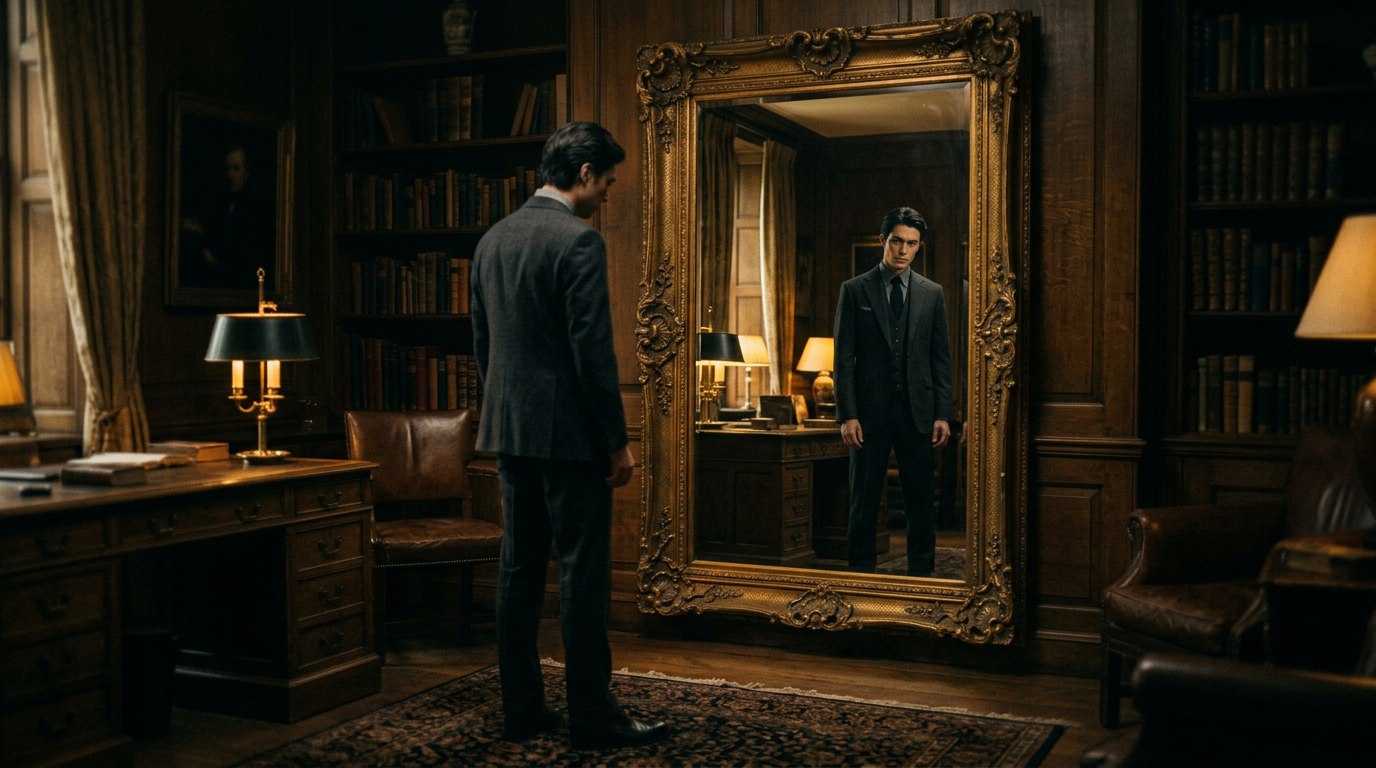
Before you can direct a team, a market, or a family, you must first govern the small, unwitnessed kingdom of your own habits, moods, and reactions. Authority over others is borrowed; authority over yourself is earned, and it is the only kind that survives contact with pressure. The title of leader is granted by an org chart, but the practice of leadership begins in the mirror, long before anyone else is watching.
The executive lens
Every organization eventually becomes a photograph of its leader's self-discipline. The executive who is chronically late trains a culture of lateness. The one who cannot sit with an uncomfortable number in a board meeting trains a culture that hides uncomfortable numbers. Teams do not follow instructions nearly as closely as they follow behavior, and behavior is simply self-leadership made visible to a room.
This is why the highest-leverage work an executive can do is invisible: the early wake-up before the market opens, the pause before the sharp reply in a heated email thread, the daily audit of where their own energy and integrity leaked. Self-leadership is not a soft prerequisite to the real work of running a company. It is the real work, executed first in private so that it can be trusted in public.
Key lessons
- Command follows composure. People will grant you authority over strategy long before they grant you authority over their trust, and trust is built by watching how you handle yourself under strain.
- Standards are inherited, not announced. A team absorbs its leader's actual habits, not their stated values, so the fastest way to change a culture is to change your own behavior first.
- Private discipline is the source of public credibility. The decisions no one sees you make are the ones that determine whether the decisions everyone sees you make will be trusted.
- Self-leadership scales; self-neglect compounds. Every unmanaged flaw in a leader gets amplified, not diluted, as the organization grows around them.
Symbolic parable
The Clockmaker's Apprentice
In a mountain village there lived a clockmaker famous for the precision of his instruments, and every year he took on a single apprentice to learn the trade. One winter, an eager young man arrived, certain that greatness meant learning to build the grandest clock in the valley as quickly as possible. He watched the old man work and noticed something strange: before touching a single gear for a client, the clockmaker spent an hour each morning alone, disassembling and reassembling his own pocket watch, the plainest one he owned. The apprentice asked why he wasted such time on an instrument no customer would ever see. The old man replied that a clockmaker who could not keep his own time honestly had no business promising anyone else theirs.
Years passed, and the apprentice grew skilled, but impatient with the ritual, he began skipping his own morning discipline to get to the paying work faster. His clocks were beautiful at first glance, yet one by one they began to drift, losing a minute here, gaining one there, and customers who once trusted him began to ask other craftsmen for repairs. When he finally returned to the old man for guidance, the clockmaker simply pointed to the apprentice's own wrist. The watch he wore was eleven minutes slow. He had been so consumed with building trustworthy time for others that he had let his own run wild.
“No instrument keeps a truth it does not first keep for itself.”
The Reflection Audit
-
01
Name your unwatched hour
Identify the one hour of your day when absolutely no one is observing you, and write down honestly what you actually did with it this week.
-
02
Trace one behavior downstream
Pick a single habit of yours, good or bad, and list three ways your team has visibly started to mirror it.
-
03
Set one private standard
Choose one discipline you will hold yourself to for the next seven days with zero audience, and track it only for your own eyes.
Marcus's story
Marcus ran operations for a fast-growing logistics company and prided himself on his open-door policy, yet he answered emails at midnight, skipped lunch to "stay sharp," and snapped at vendors when shipments slipped. He assumed his team respected his work ethic. Instead, his directors quietly began doing the same: skipping meals, answering him at all hours, and snapping at their own reports in turn. Turnover crept up in the one department that touched him most directly, and Marcus blamed the market for the churn.
A mentor finally asked him a blunt question: what would his team look like if they behaved exactly as he did, all day, every day? Marcus sat with that for a long night. He rebuilt his own mornings first — protected sleep, a real lunch, a firm cutoff on messages after eight — and said nothing about it to his team. Within two months, without a single memo on culture, his directors' hours normalized on their own. He had stopped managing behavior and started leading it, from the only place leadership actually starts.
Conclusion
The people who change organizations, families, and rooms rarely do it through the force of their announcements. They do it through the quiet, repeated evidence of a person who has already done the harder work of leading themselves, and who therefore has something real to offer everyone else.
Lead yourself first, and leadership will follow you everywhere.
Continue the journey
Read The High-Performance Executive
Volume 2 of Thoughts for Life brings together 63 wisdoms on clarity, purpose, decision-making, and leading yourself before you lead others.
Go deeper
What becomes possible when you live this wisdom?
Coaching turns reflection into a focused next move, for your work, your leadership, and the life you are building.
Explore coaching